The Fall
The Homecoming
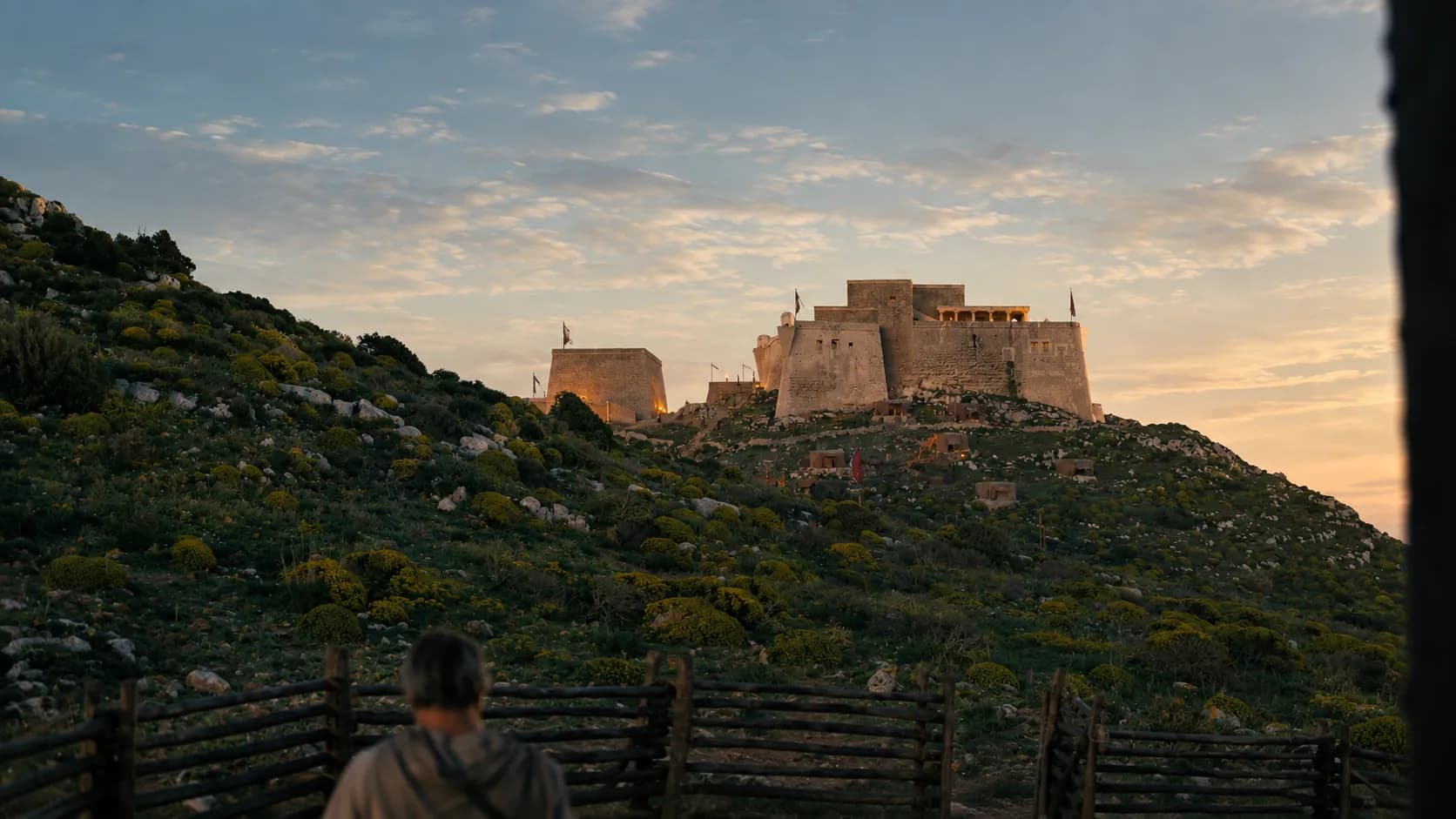
The Watchman on the Roof
Aeschylus's Agamemnon opens with one of the most famous prologues in drama. A watchman lies on the palace roof, where he has been stationed for a full year, scanning the horizon for a beacon signal: “I ask the gods for release from this weariness — this watch of a year's length, during which, lying on the roof of the house of Atreus like a dog, I have come to know the assembly of the night's stars.”
He is exhausted, lonely, and afraid. He hints at dark secrets in the palace — “the house itself, if it could speak, would tell the tale most clearly; I speak to those who know, and to those who do not know, I forget.” The entire household knows about Clytemnestra and Aegisthus. No one dares speak.
The Beacon Chain
When the watchman finally sees the fire, Clytemnestra describes the chain of beacons that carried news of Troy's fall overnight — from Mount Ida above Troy, to the island of Lemnos, to Mount Athos, across the Saronic Gulf, through the peaks of Euboea and Boeotia, over Mount Cithaeron and the cliffs of Corinth, to Mount Arachnaeus — the final peak visible from Argos.
She recounts this chain with pride — a dazzling display of her intelligence and control. She designed this signal system. She has been preparing for this night for years.
The Return
After ten years at Troy and a harrowing journey home, Agamemnon finally returned to Mycenae. He brought with him the spoils of war and Cassandra, the Trojan princess cursed by Apollo to speak true prophecies that no one would believe.
The Prophecy of Cassandra
Standing before the palace, Cassandra fell into prophetic frenzy. She smelled blood: “The house reeks of blood and slaughter.” She saw the ghosts of Thyestes' murdered children — “weeping for their own death, their flesh roasted and eaten by their father.”
She saw the net that would trap Agamemnon: “A net — a net of Hades! And the snare is she who shares his bed, his murderess.” She saw her own death: “I too shall fall. She will kill me too, the wretched stranger.” She even saw the avenger who would come — “a son who kills his mother, a wanderer returning” — a prophecy of Orestes.
The Chorus, true to Apollo's curse, could not understand or believe her. They admired her frenzied poetry but dismissed her warnings. Cassandra, knowing she went to her death, removed her prophetic garlands and entered the palace anyway.
Clytemnestra's Revenge
For ten years, Clytemnestra had nursed her rage. The Chorus describes her as having “a man-counseling, expectant heart.” She took Aegisthus — son of Thyestes, sired through incest for the specific purpose of vengeance — as her lover and co-conspirator. She effectively ruled Mycenae as regent, managed the palace guard, and ensured no loyalist could warn Agamemnon. She sent Orestes away to Phocis, removing the one male heir who might challenge her.
Her patience itself becomes a theme: she waited ten years, and when the moment came, she was completely ready.
The Purple Tapestries
When Agamemnon arrived, Clytemnestra ordered servants to spread crimson-dyed tapestries from his chariot to the palace door. She invited him to walk upon them: “Let not his foot, that has destroyed Troy, touch the common earth.”
Agamemnon hesitated: “Such honors are for gods, not mortals. I am a mortal man; I cannot walk upon embroidered splendors without fear.” To walk on such costly fabrics was hybris — the supreme transgression, a mortal presuming to live as a god. Clytemnestra pressed him: “Would Priam have done it, had he conquered?” He answered: “He would indeed.” “Then do not fear the blame of men.” He relented.
The symbolism operates on multiple levels. The color — crimson, purple — is the color of blood and of royalty. He walks a path of blood into his own death. These fabrics were worth their weight in silver; destroying them underfoot is the same wasteful excess that led him to sacrifice his daughter. Clytemnestra tested whether he could be manipulated through vanity. He could. The moment he stepped onto the tapestries, he crossed symbolically from the world of the living into the realm of the dead.
He stepped on the purple cloth. He entered his palace. She drew him a bath.
“She cast a net over him — a robe with no openings for his arms or head — and struck three times. He fell in the bath, and the water turned red.”
The Death of a King
Trapped in the net-like robe, unable to defend himself, Agamemnon — the man who had commanded the greatest army the world had ever seen — died helpless. Clytemnestra killed Cassandra as well. When the deed was done, she stood over the bodies and declared her justice to the people of Mycenae.
In Aeschylus' telling, she showed no remorse:
“He fell, and as he gasped, his blood sprayed me with dark drops of crimson rain — and I rejoiced, as the sown earth rejoices in the glad rain of heaven.”
The Sequence
The Greeting
Clytemnestra welcomes Agamemnon as a loyal wife
The Purple Tapestries
She lays out royal cloth — hubris made visible
The Bath
She draws a bath for the weary king
The Net
A robe with no openings — he is trapped
Three Strikes
She strikes three times with the axe
Death
The conqueror of Troy dies helpless in his bath
The Cycle Continues
But the curse of the House of Atreus did not end with Agamemnon. His son Orestes, raised in exile, returned years later to avenge his father. He killed Clytemnestra and Aegisthus — matricide to avenge patricide.
Pursued by the Furies for the crime of killing his mother, Orestes was eventually tried before Athena's court in Athens. He was acquitted, and with that verdict, the cycle of blood vengeance that had consumed the House of Atreus for generations was finally broken.
But Agamemnon was long dead by then — a king who conquered Troy and lost everything at home.
The Curse of the House of Atreus
Tantalus
Murders his son Pelops
Atreus
Feeds Thyestes’ children to him
Agamemnon
Sacrifices Iphigenia
Clytemnestra
Murders Agamemnon
Orestes
Kills Clytemnestra — tried and acquitted by Athena
Cycle Broken