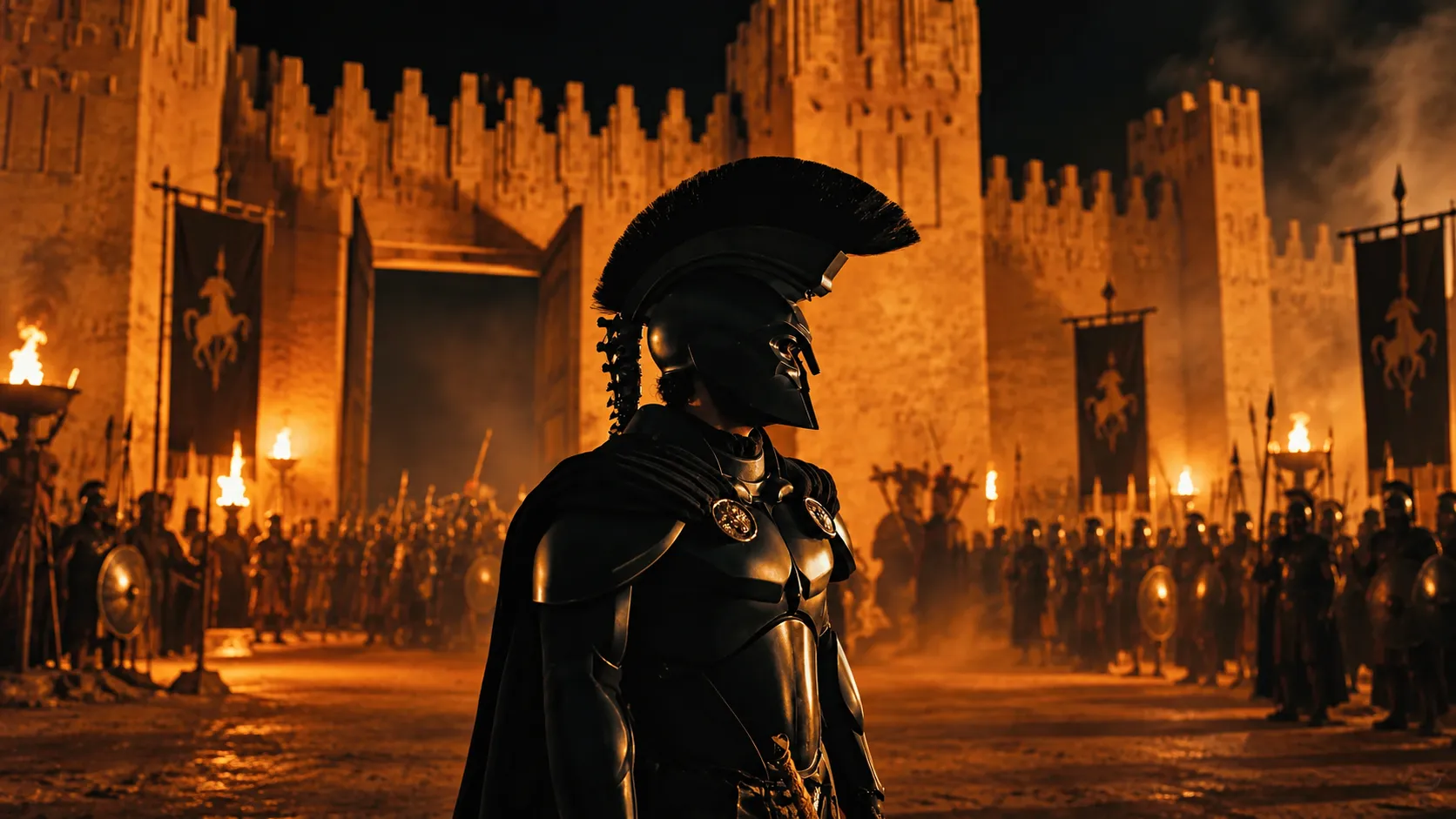
The Man
Son of Atreus
The Cursed Bloodline
The House of Atreus was stained with blood long before Agamemnon drew his first breath. His grandfather Tantalus slaughtered his own son Pelops and served him as a feast to the gods — a transgression that cursed every generation to follow.
His father Atreus continued the cycle, murdering his brotherThyestes' children and serving them at a banquet. Vengeance begat vengeance. Into this legacy of horror, Agamemnon was born — a prince destined for greatness and destruction in equal measure.
Tantalus
Served his son to the gods
Pelops
Betrayed and murdered his benefactor
Atreus
Fed his brother’s children to him
Agamemnon
Sacrificed his daughter for war
King of Mycenae
Mycenae was the jewel of the ancient world — its walls built by Cyclopes, its treasury overflowing with gold, its Lion Gate standing as a monument to power. When Agamemnon claimed its throne, he inherited not just a kingdom but an empire.
He was recognized as the most powerful ruler among the Greek kings — not necessarily the bravest warrior or the wisest leader, but the one who commanded the most wealth, the largest army, and the deepest network of alliances. His authority was political as much as personal.
The Path to the Throne
The path to Mycenae was violent. After Atreus's death, Thyestes briefly held the throne. The young Agamemnon and Menelaus were driven into exile, taking refuge with King Tyndareus of Sparta. In some versions, Clytemnestra was already married to Tantalus, son of Thyestes — Agamemnon's own cousin. Agamemnon killed Tantalus and Clytemnestra's infant son, then married her by force.
In Euripides' Iphigenia at Aulis, Clytemnestra throws this history in Agamemnon's face: “You took me by force — you killed my first husband and my baby, torn from my breast.” He then marched on Mycenae and drove out Thyestes, installing himself as king. Through the city's existing wealth, strategic marriages, and military power, he made himself the most powerful king in Greece.
The Politician
Homer portrays Agamemnon as a deeply political figure. He holds the skeptron — the scepter — which Homer traces through a divine lineage: forged by Hephaestus, given to Zeus, passed through Hermes, Pelops, Atreus, Thyestes, and finally to Agamemnon. It is not decorative. It is the symbol of divinely sanctioned authority.
His political skills are visible in how he managed the coalition. In Book 2 of the Iliad, he tested the army's morale by suggesting they all sail home — the army stampeded for the ships, and only Odysseus stopped them. He conducted councils, heeded Nestor, and maintained his coalition of twenty-nine independent kings for ten years — a feat of extraordinary political stamina.
In the embassy to Achilles, Agamemnon offered staggering gifts: seven tripods, ten talents of gold, twenty cauldrons, twelve prize-winning horses, seven women of Lesbos, the return of Briseis unsworn that he had not touched her, and the hand of any of his three daughters in marriage with seven cities as dowry. Achilles rejected all of it. But the sheer scale reveals both Agamemnon's wealth and his understanding that Achilles' return required appeasement, not command.
Rich in Gold
Homer repeatedly calls Mycenae polychrysos — “rich in gold.” Agamemnon's armor is described in extraordinary detail: a corselet with bands of dark blue enamel, gold, and tin; ten bands of lapis lazuli on its front; a shield with a Gorgon's head; a sword with gold studs and a silver scabbard hung on gold chains. His brother Menelaus's palace in Sparta gleamed “like the light of the sun or the moon” — and Menelaus was the poorer brother.
Among the Kings
Achilles surpassed him in martial prowess but commanded only fifty ships. Odysseus surpassed him in cunning but ruled rocky Ithaca with twelve. Ajax was the wall that never broke but had no political authority. Nestor surpassed him in wisdom but wielded only advisory power. Diomedes wounded gods but deferred to Agamemnon's command.
Agamemnon alone combined sufficient wealth, military resources, political legitimacy, and dynastic prestige to unite them all. He was the anax andron — “lord of men” — Homer's epithet for him, used for no other Greek king. The title may preserve a memory of the Mycenaean wanax, the actual title of the paramount king in Bronze Age palatial society.
The Family
He married Clytemnestra, daughter of Tyndareus and sister to Helen — the woman whose face would launch a thousand ships. Together they had four children: Iphigenia, Electra, Chrysothemis, and Orestes.
His brother Menelaus married Helen and became King of Sparta. The two brothers formed the axis around which all of Greece would turn when Paris of Troy disrupted the fragile peace of the ancient world.
Wife
Clytemnestra
Daughter of Tyndareus, sister of Helen
Brother
Menelaus
King of Sparta, husband of Helen
Children
Iphigenia, Electra, Chrysothemis, Orestes
Legacy and ruin
Nemesis
Aegisthus
Son of Thyestes, lover of Clytemnestra
“A king is not made by the crown he wears, but by the burdens he carries — and the choices those burdens demand.”
When word reached Mycenae that Paris had abducted Helen, Agamemnon saw the moment he had been waiting for. Not merely a rescue mission — but a chance to unite all of Greece under his command and prove, once and for all, that the House of Atreus was destined to rule.